The Whiteboard
A collaborative whiteboard for client workshops — realtime multiplayer, diagramming, facilitation tools — living inside the Ionic client portal. Built in roughly 24 hours of AI-first development, for pennies a month. This page is really about the question that raises: how viable is it now to build your own replacement for the SaaS tools you rent?
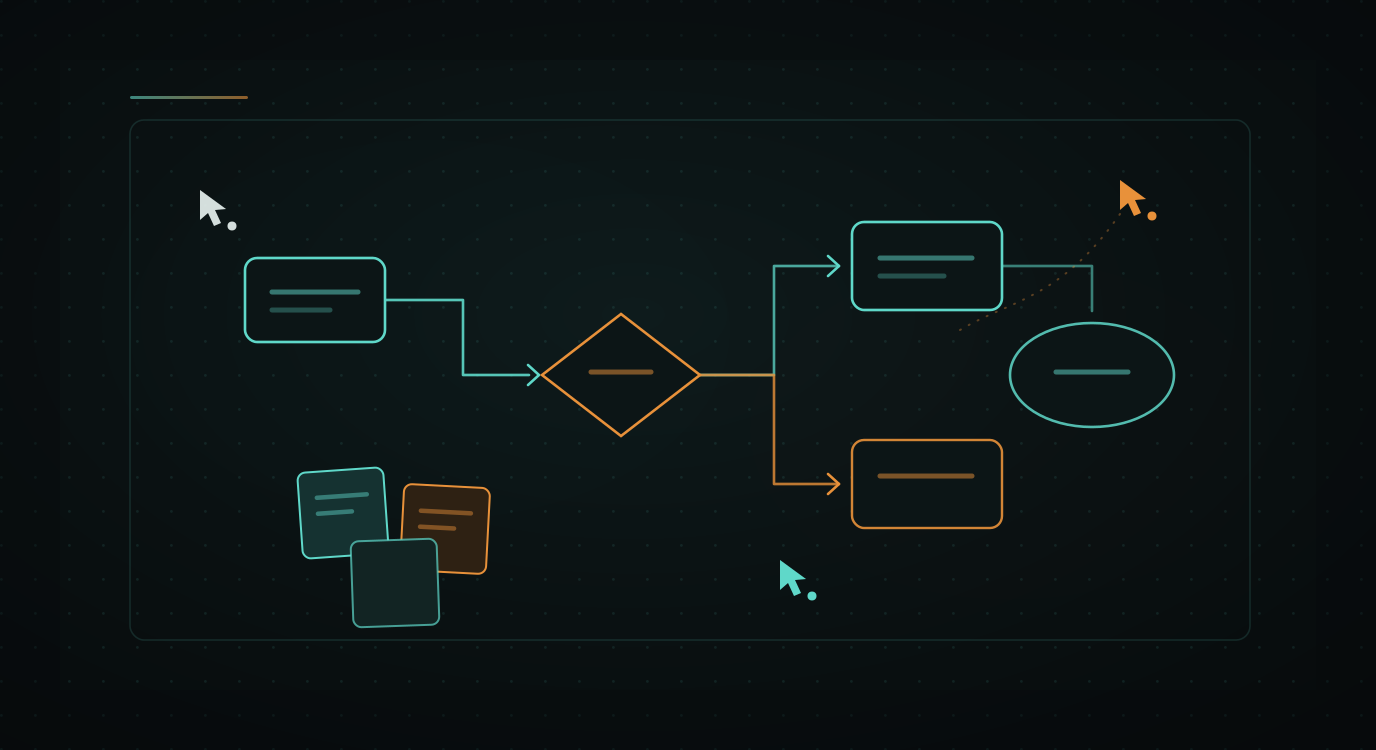
I run workshops for a living — fares and ticketing strategy, requirements sign-off, options appraisals. That work lives on shared canvases, which normally means Miro or Figma's FigJam, per-seat pricing, and my clients' thinking sitting on someone else's servers. I wanted the same class of tool inside my own client portal, behind my own access controls, on my own infrastructure.
So I built one. Or more precisely: I described it, argued about it, and reviewed it — while Claude built it. The whole thing went from a blank scoping document to a deployed, multiplayer, client-facing tool over about twenty-four hours of elapsed time, in seventeen planned passes, each one a reviewed pull request with tests.
01What it does
Realtime multiplayer
Live cursors, presence avatars, follow-a-colleague and bring-everyone-to-me — conflict-free sync so nobody overwrites anybody.
Workshop facilitation
A shared timer, hidden-until-reveal dot voting with a stamped results card, emoji reactions, and sticky-note stacks that deal a note per click, author-stamped.
Proper diagramming
Bound connectors and elbow routing, Mermaid text-to-diagram, one-click auto-layout, community stencil libraries (AWS, Azure, UML, BPMN…) grouped and searchable.
Frames & presenting
Frames become slides; a presenter walks the room through them without moving anyone else's viewport.
Data-driven shapes
Fields on any shape, colour-by-value rules, label templating and progress bars — Visio's shape data, on a whiteboard.
Guests with a kill switch
Clients join with a link — no account, scoped to one board if I choose — and revoking the link ends every guest session instantly.
Comments & deep links
Anchored comment threads with identity, boards that link into each other, and element-level deep links.
An AI collaborator
The board has an MCP endpoint, so Claude can generate, tidy and edit boards directly — an org chart from pasted CSV appears on everyone's screen live.
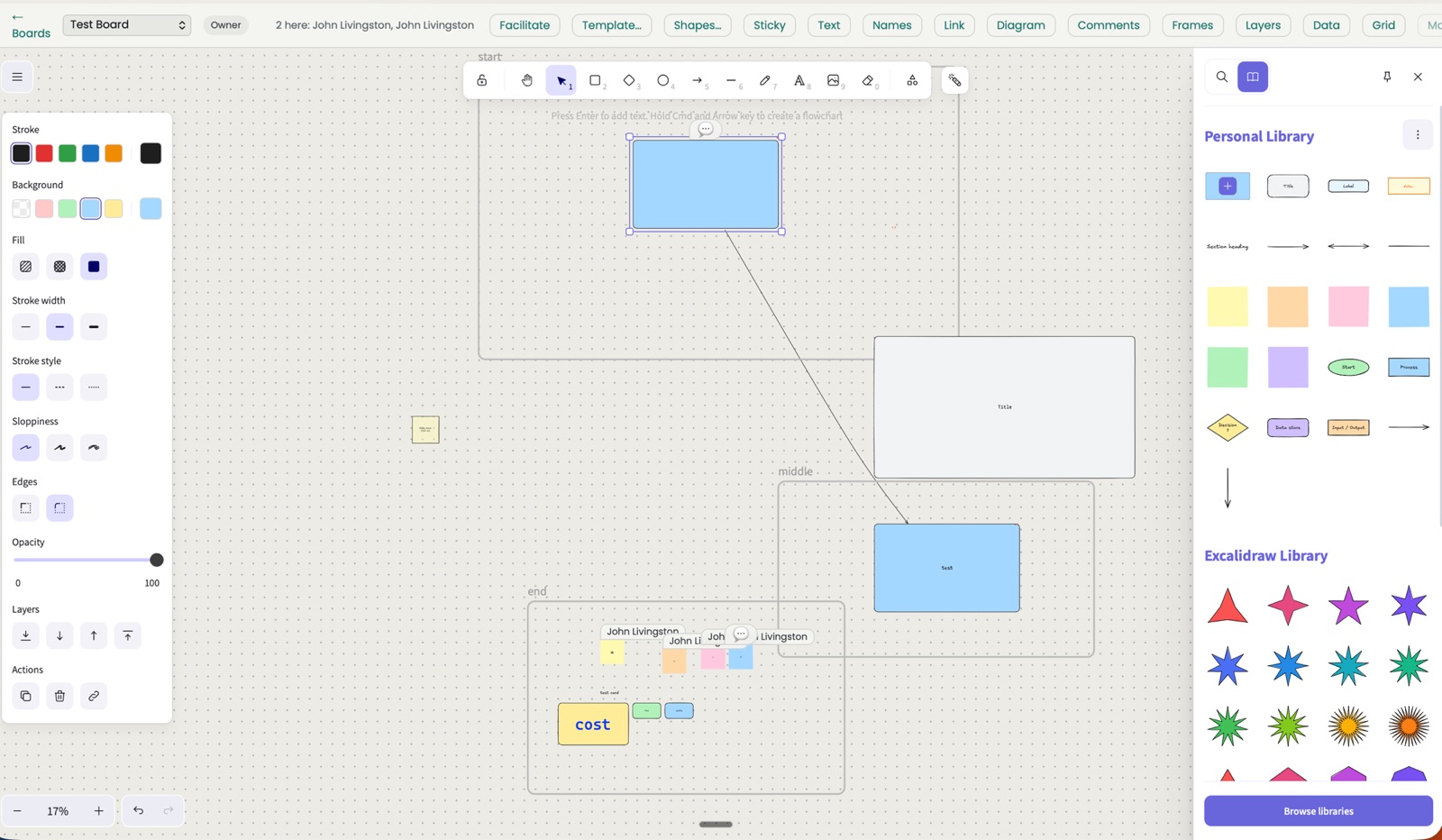
> mid-build test session — two of me, arguing productively
02The honest version of "built in 24 hours"
Let's be precise about the claim, because this is where most vibe-coding stories go soft. I did not build a drawing engine in a day — nobody does. The canvas is Excalidraw, a superb MIT-licensed editor, and standing on it is the whole point. What got built in those twenty-four hours is everything that turns a canvas component into a collaborative service: the realtime sync layer, persistence, authentication and roles, guest sessions, the facilitation kit, comments, presentation mode, the diagram engine integration, exports, and the AI hooks. That's the part you're actually paying Miro for.
And it wasn't one heroic prompt. It was a scoping document first, decisions argued and written down, then passes built branch-by-branch with tests, deployed, and walked through by hand. The walkthroughs mattered: automated tests proved the buttons existed; clicking them found the two that didn't work. Each bug went from screenshot to diagnosed, fixed and redeployed in minutes — that turnaround loop, not the initial generation, is what makes the whole approach viable.
03So — should you cancel your SaaS subscriptions?
Some of them, genuinely, maybe. The economics have shifted for a specific class of tool: the ones where you use a fifth of the features, the per-seat pricing punishes you for inviting guests, and the data would rather live on your infrastructure than theirs. Collaboration tools sit squarely in that class. This whiteboard costs roughly nothing to run, has exactly the features my workshops need and none I don't, and my clients' material stays inside a portal I control end to end.
The caveats are real, though. This is a tool for one consultancy and its clients, not a hardened product for ten thousand strangers — no billing, no SOC 2, no support desk. It leans on a world-class open-source core, which not every category has. And it needs an owner who'll treat it like software: version control, tests, reviewed changes. "Vibe coding" that skips those is how you get something that demos brilliantly and falls over in your first real workshop.
But the shape of the conclusion is hard to argue with: a working, multiplayer, client-ready replacement for a well-known SaaS category, built conversationally in a day, running for pennies. Five years ago that sentence would have been fantasy. Now it's a line item I stopped paying.
Want the thinking pointed at your problem?
The whiteboard itself lives inside the Ionic client portal, so there's no public demo — clients get a link and a board. If you're curious what AI-first building could replace in your own stack, that's a conversation I enjoy having.
john@ionicconsulting.co.uk